
In every chemical process, laboratory test, or environmental analysis, knowing the exact pH of a solution is crucial. From ensuring safe drinking water to maintaining the right chemical balance in pharmaceuticals and food production — accurate pH measurement forms the foundation of quality control. Achieving such precision is made possible through a sophisticated device known as the pH meter.
As a leading laboratory and industrial instruments manufacturer, Harrier Enterprises designs and manufactures high-performance pH meters that provide fast, reliable, and precise readings. In this blog, we will explore what a pH meter is, its working principle, internal structure, different types, and why it has become indispensable in modern scientific and industrial operations.
What is a pH Meter?
A pH meter is an electronic instrument used to measure the hydrogen ion concentration (acidity or alkalinity) of a liquid solution. It provides readings on a scale ranging from 0 to 14, where:
- pH < 7 indicates acidity,
- pH = 7 indicates neutrality, and
- pH > 7 indicates alkalinity (basic nature).
Instead of using traditional pH indicator papers or chemical titration methods, a pH meter provides quick, accurate, and digital measurements, making it a vital instrument in scientific and industrial operations
Working Principle of a pH Meter
The pH meter works on the electromotive force (EMF) principle, which measures the voltage difference between two electrodes — the glass electrode (measuring electrode) and the reference electrode.
When both electrodes are immersed in a solution, the glass electrode develops a potential that varies with the hydrogen ion concentration, while the reference electrode maintains a constant potential. The difference in potential is converted into a pH value by the meter using the Nernst equation:
E=E0−2.303RTnFlog[H+]E = E_0 – \frac{2.303RT}{nF} \log[H^+]E=E0−nF2.303RTlog[H+]
Where:
- E = Measured potential difference
- E₀ = Standard electrode potential
- R = Gas constant
- T = Temperature (Kelvin)
- n = Number of electrons involved
- F = Faraday’s constant
The pH meter’s internal circuit converts this voltage into a readable pH value displayed on the digital screen.
Internal Components & Diagram of a pH Meter
A standard pH meter consists of the following key parts:
- Glass Electrode: Sensitive to hydrogen ions and responsible for generating potential based on ion activity.
- Reference Electrode: Provides a stable voltage for comparison.
- Temperature Sensor: Adjusts the reading for temperature variations to ensure accuracy.
- Amplifier Circuit: Strengthens the weak signal from the electrodes.
- Microprocessor & Display: Converts electrical signals into a pH value and displays it digitally.
- Calibration Knobs or Buttons: Used to standardize the meter using buffer solutions (pH 4, 7, and 9.2).
Simplified Working Flow: Diagram
[Glass Electrode] → [Amplifier] → [Processor] → [Display]
| ↑
[Reference Electrode] ———————|

Types of pH Meters
1. Benchtop pH Meter:
Used in laboratories for high-precision analysis. These models have advanced calibration features and temperature compensation for scientific accuracy.
Applications:
- Research laboratories
- Pharmaceutical testing
- Food and beverage quality control
2. Portable pH Meter:
Compact and battery-operated, designed for on-site or field applications. Ideal for water testing in environmental and agricultural projects.
Applications:
- Field research
- Environmental water quality checks
- Agricultural soil testing
3. Handheld Pen-type pH Meter:
Affordable, small, and easy to use — these meters are great for routine testing and quick results.
Applications:
- Aquariums and swimming pools
- Hydroponics and horticulture
- Educational purposes
4. Online/Industrial pH Meter:
Designed for continuous pH monitoring in large-scale industrial processes. These are connected directly to control systems or SCADA.
Applications:
- Wastewater treatment plants
- Chemical and food industries
- Power plants and distilleries
Calibration Process of a pH Meter
Accurate calibration is essential for precise readings.
Steps for Calibration:
- Clean the electrode with distilled water and gently blot dry.
- Immerse the probe in a pH 7 buffer solution and calibrate.
- Repeat using pH 4 and pH 9 buffer solutions for multi-point calibration.
- Rinse after each use and store the electrode in a storage solution.
Calibration should be performed daily or before each critical measurement.
Factors Affecting pH Measurement
- Temperature: Affects the electrode potential and pH value.
- Electrode Condition: Dirty or aged electrodes can lead to inaccurate readings.
- Contamination: Impurities in the solution can distort results.
- Calibration Quality: Use fresh and standardized buffer solutions.
Maintaining the electrodes and following proper calibration ensures long-lasting accuracy.
Advantages of Using a pH Meter
- Delivers fast and precise results
- Simple to use with digital output
- Suitable for a wide range of liquids and environments
- Minimizes manual calculation and human error
- Enables continuous pH monitoring in industrial setups
Applications of Harrier Enterprises pH Meters
Harrier Enterprises manufactures and supplies pH meters that are suitable for a wide range of sectors:
- Water & Wastewater Treatment: Monitoring and controlling effluent discharge.
- Pharmaceutical Industry: Ensuring product consistency and chemical balance.
- Food & Beverage: Maintaining safety and quality during production.
- Agriculture & Soil Testing: Measuring soil pH for better crop yield.
- Chemical Industry: Monitoring process reactions and quality control.
- Educational Institutions & Research Labs: For teaching and laboratory experiments.
Harrier Enterprises – Leading Muffle Furnace and Laboratory Equipment Manufacturer
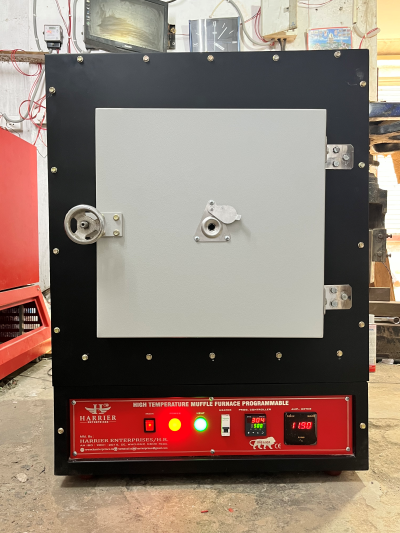
As a leading Muffle Furnace Manufacturers, Harrier is well known for its excellence in manufacturing Muffle Furnaces, the company also provides a range of precision laboratory instruments and testing equipment trusted by scientists, researchers, and industries alike. Our advanced thermal and analytical technology ensures every product — including pH meters and other lab devices — is designed with accuracy, reliability, and innovation in mind.
Conclusion:
A pH meter is more than just an analytical device—it’s a critical instrument for maintaining quality, safety, and efficiency across countless scientific and industrial processes. Understanding its principle, structure, and usage helps ensure correct application and dependable results.With its dedication to innovation and precision engineering, Harrier Enterprises continues to lead as a manufacturer of advanced laboratories, industries thermal equipment.